APIs and the Future of Publishing Workflows
The publishing industry has undergone a major transformation over the past decade. What was once a largely manual and document-driven process is increasingly becoming automated, data-driven, and interconnected. At the center of this shift are APIs (Application Programming Interfaces), which allow different software systems to communicate with each other efficiently. For companies working with structured document workflows—such as those using platforms like UBL-based solutions—APIs play an essential role in streamlining operations.
In traditional publishing environments, documents often move through several disconnected systems: authoring tools, editorial review platforms, layout software, content management systems, and distribution channels. Each step may involve manual file transfers, format conversions, or repetitive data entry. APIs change this dynamic by creating direct, automated connections between systems.
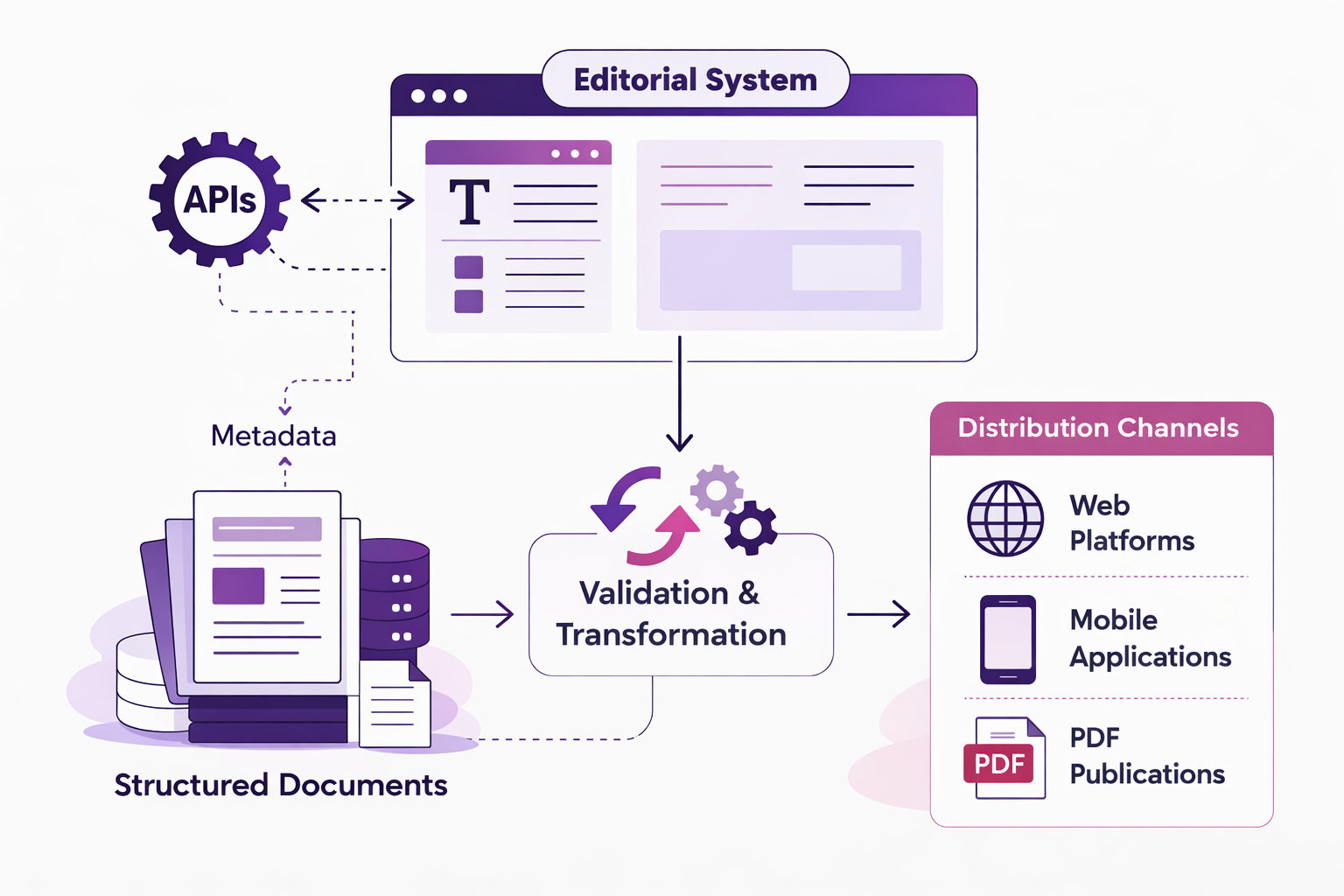
For example, when an author submits content through an editorial system, an API can automatically send that content to a structured document platform for validation and transformation. The same API can pass metadata—such as author information, publication date, or document type—ensuring that all systems maintain consistent information. In environments that rely on structured standards like UBL, APIs make it possible to validate documents against schemas, transform them into multiple output formats, and distribute them across digital platforms with minimal manual intervention.
Another advantage of APIs in publishing is scalability. Modern publishing organizations often manage thousands of documents across multiple channels: web platforms, mobile applications, PDF publications, and machine-readable formats. APIs enable automated pipelines where a single source document can be transformed into many formats and delivered to different systems instantly.
APIs also support interoperability, which is increasingly important in industries that depend on standardized data exchange. By exposing well-defined endpoints, platforms can allow external systems—such as government portals, document repositories, or analytics tools—to access and process publishing data without requiring complex integrations.
For solutions related to structured document management, APIs serve as the backbone of automation. They allow developers to build workflows where document validation, transformation, enrichment, and distribution happen seamlessly in the background.
As publishing continues to evolve toward structured, machine-readable content, APIs will remain a key enabler. They not only reduce manual work but also open the door to more flexible, scalable, and intelligent publishing ecosystems—where information flows smoothly between systems, organizations, and platforms.